
From Power Shortages to Baseload Stability: HYDRO-LINK’s 400kV Angola – DRC Interconnection
As power shortages continue to constrain industrial growth in southeastern DRC, HYDRO-LINK’s proposed 720 miles long, 400kV interconnection will transmit 1,200MW of surplus Angolan hydropower into the region’s mining corridor – positioning cross-border transmission as a commercially grounded solution to baseload instability.
In this interview, Paul Hinks, Chairman of HYDRO-LINK, outlines how the Independent Transmission Company model supports regulatory alignment between Angola and the DRC, and why engagement from the U.S. International Development Finance Corporation, U.S. Export-Import Bank and U.S. Trade and Development Agency is reinforcing investor confidence in large-scale African infrastructure.
1. HYDRO-LINK is set to become one of the longest 400kV transmission interconnections in the region. What will be the impact of the project once completed?
HYDRO-LINK will deliver 1,200 MW of reliable, low-cost electricity to one of Africa’s most economically and strategically important regions.
There is a very high suppressed demand in the region and firm baseload supply will enable the expansion of mines, downstream mineral processing, and broader industrial development.
For industrial users, this means operational certainty and much lower energy costs. For the communities, it means dependable electricity and improved quality of life.
2. Cross-border transmission projects are complex by nature. What has been key to aligning Angola and the DRC around a shared commercial and regulatory framework?
Angola and DRC are very aligned with one another. There are some challenges around harmonising two different regulatory frameworks, but both countries have a very positive approach towards addressing them and working with one another to do that.
From the outset, the project has been developed as an Independent Transmission Company on a non-recourse project finance basis. That requires regulatory clarity, bankable power purchase arrangements, defined cross-border trading rights, and predictable commercial terms. These principles are understood by both governments and their regulators.
Angola has surplus hydropower capacity and at the same time the DRC’s mining and industrial sectors face daily power interruptions and a severe lack of capacity for their growth. When economic incentives are clear, alignment becomes easy, practical and durable.
It is true that cross-border projects are inherently complex. However, when the commercial structure is transparent, the risk allocation is clear, and the economic upside is shared, that complexity becomes manageable.
3. How will HYDRO-LINK strengthen energy security and grid reliability in the DRC, particularly in high-demand industrial regions such as the Copperbelt?
HYDRO-LINK is new infrastructure and it will be built with the highest quality products from the United States. This alone will provide reliability compared to other transmission infrastructure.
The project’s 400kV transmission line infrastructure and its five substations will ensure voltage control, system stability, and high-capacity power transfer despite its long length.
The Industrial demand in southeastern DRC significantly exceeds the available supply. Mining and processing facilities often rely on excessively expensive diesel generators for their operations. By transmitting 1,200 MW of hydropower from Angola into the DRC’s Lualaba Province, HYDRO-LINK will provide dependable capacity.
Energy security is not just about access to power it is also about stability and predictability. HYDRO-LINK diversifies supply, strengthens cross-border interconnection, and provides the mining sector and other industries with the operational certainty they need to support long-term investment and expansion.
4. HYDRO-LINK is a private-sector led initiative. What does this signal about investor confidence in large-scale African infrastructure?
HYDRO-LINK’s 400kV transmission infrastructure and advanced substations are designed to ensure voltage control, system stability, and high-capacity power transfer. This improves reliability and reduces the risk of outages or operational disruptions in the region’s most economically critical corridor.
This project will demonstrate that large-scale African infrastructure can attract serious private capital providing it is commercially grounded, professionally structured and bankable.
HYDRO-LINK is an Independent Transmission Company that is developing the project on the basis of non-recourse project finance, with anchor-client and credit-worthy private sector industrial demand and defined regulatory frameworks in both Angola and the DRC. This structure, especially as it relates to offtake, builds enhanced confidence with prospective equity partners and international lenders who understand transmission assets and disciplined infrastructure finance.
Investors respond to fundamentals. Angola has surplus hydropower capacity, and southeastern DRC has sustained industrial demand. A transmission line is an entirely static asset, with no rotating equipment like a power plant. This greatly reduces operational risk and operation and maintenance costs. It is a very long-term, revenue-generating infrastructure asset with a clear and defined economic rationale.
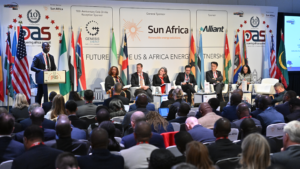
5. With the Powering Africa Summit taking place in Washington, D.C., how important is U.S. engagement in advancing projects like HYDRO-LINK?
For decades, we in the United States have heard rhetoric from governments around Africa who have been critical of U.S. investors “not showing up,” often telling us how China is building most of Africa’s infrastructure, and they are of course correct.
But things are changing as we speak because now the U.S. administration is highly focused on commercial engagement, as opposed to being a donor nation beset by waste. To this end the United States has restructured its development portfolio by empowering US DFC, US EXIM and USTDA with renewed desire and increased support for private investment projects in Africa, provided that they are commercially bankable. This means that by working with U.S. government agencies, investors like HYDRO-LINK can compete with anyone in the world, including China.
The role of U.S. development finance and export credit institutions is critical for US companies to succeed. Early-stage project preparation, feasibility studies, and long-term financing support can materially accelerate the path to financial close. When U.S. institutions engage, they provide rigorous due diligence and help catalyse additional private investment.
The HYDRO-LINK project incorporates significant U.S. engineering experience and expertise, advanced transmission technology, and high quality, high-performance materials and equipment. This means longer life-cycles and enhanced reliability.
There is also a broader strategic dimension to the HYDRO-LINK project. Reliable electricity in the DRC’s mining regions supports global supply chains for the supply of critical minerals such as copper, cobalt and lithium.
The Powering Africa Summit in Washington, D.C. underscores the policy changes that are being implemented in 2025/2026, and the future role of United States investors in the African arena. HYDRO-LINK is a great example of how US investors will play a major role in Africa’s future.
6. Beyond power delivery, what lasting economic or institutional impact do you expect HYDRO-LINK to have on the region?
The Angola to DRC transmission line is the first of what we expect to be a number of HYDRO-LINK investments, with others already planned around the continent. The concept of moving bulk power from one country to another to alleviate power deficits has not been fully embraced by the private sector, but as more generation capacity is introduced, and surpluses are evident, it is very likely that we will see more developers enter the market.