
EXCLUSIVE: Zambia’s IDC moves Chisamba Solar towards financial close
Cornwell Muleya, Chief Executive of Zambia’s Industrial Development Corporation, tells ENN how the IDC is moving Chisamba Solar and the rest of its renewable pipeline towards financial close, and why he expects power supply to grow in step with demand from the mines as Zambia works towards three million tonnes of copper a year by 2031.
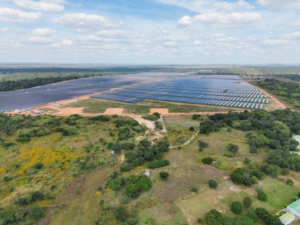
The Industrial Development Corporation’s solar project at Chisamba, in Central Province north of Lusaka, is among the projects in its renewable pipeline closest to financial close, a 67MWp plant the IDC is co-developing with Solarcentury Africa under heads of terms signed in January 2025, with close targeted for February 2027.
Bangweulu and Ngonye, Zambia’s first two utility-scale solar plants under Scaling Solar, were co-developed by the IDC, which as majority shareholder in ZCCM Investments Holdings also has a direct stake in the copper industry whose growth will account for much of Zambia’s new power demand. In written answers to ENN, Chief Executive Cornwell Muleya sets out where that pipeline stands and how far the IDC’s mini-grid programme has come.
The IDC co-developed Bangweulu and Ngonye, Zambia’s first two utility-scale solar plants under Scaling Solar, and its strategic plan to 2033 includes a 480MW renewable pipeline. Which of those projects are closest to financial close, and what role will the IDC take in them?
Within IDC’s renewable energy pipeline, the Chisamba Solar Project is among the projects closest to financial close. On 30 January 2025, IDC and Solarcentury Africa Limited (SCA) executed a Heads of Terms Agreement to co-develop the 67MWp solar power plant, with financial close targeted for February 2027. IDC is therefore participating as a co-developer, working alongside SCA to advance the project towards financial close and implementation. IDC holds a minority shareholding in all its energy projects.
IDC has also facilitated the development of renewable energy projects at the Chipata West and Mufulira Ndeke sites, which were offered to ZESCO. The 100MW Chipata West project is already under construction and is approximately 50% complete. It is therefore more appropriately presented as an implementation-stage project rather than one approaching financial close.
For the Nambala site in Mumbwa District, IDC is currently seeking a strategic co-development partner. IDC’s anticipated role is to work with the selected partner to progress the site through project development and, ultimately, towards bankability and financial close.
As the majority shareholder in ZCCM-IH, how is the IDC thinking about power for the mining sector as Zambia works towards three million tonnes of copper a year by 2031?
At IDC, we regard reliable and competitively priced power as critical to Zambia’s ambition of producing three million tonnes of copper annually by 2031. As the majority shareholder in ZCCM Investments Holdings Plc, we view mining and energy as closely interconnected, with energy security forming a core part of the investment case for expanding mineral production, processing and value addition.
As mining production expands, the resulting increase in power demand will provide a stronger basis for investment in generation and transmission infrastructure. Through IDC, ZCCM-IH, ZESCO and other sector institutions, Zambia is supporting investment across the energy value chain to expand capacity and strengthen energy security. Our expectation is that power supply will grow in step with demand from the mines and related industries, ensuring that energy enables, rather than constrains, Zambia’s copper-growth and broader industrialisation agenda.
Your plan to mobilise more than $1.5 billion for priority investments draws on blended finance and pension fund partnerships among other routes. Which is proving most useful for energy, and what would help most from here?
One of the most successful financing mechanisms used for IDC’s energy projects was the World Bank Partial Risk Guarantee, particularly during the implementation of Scaling Solar Round 1, which supported the development of Zambia’s first two utility-scale solar power plants. The guarantee played an important role in facilitating private-sector participation and mobilising financing for the projects.
Following the World Bank’s withdrawal from Scaling Solar Round 2, IDC has pursued partnerships with strategic investors capable of financing project development. Going forward, greater access to de-risking and credit-enhancement mechanisms similar to the Partial Risk Guarantee used under Scaling Solar Round 1 would be particularly beneficial. Combined with strategic investor partnerships and other blended-finance structures, such support would improve project bankability, crowd in private capital and enable IDC to advance more projects in its energy pipeline towards financial close.
The plan also includes 1,000 mini-grids to reach a million Zambians. How far has that programme come, and how are sites being chosen?
The mini-grid programme remains at an early stage of development. In 2024, IDC initiated engagements with the Rural Electrification Authority (REA), ARC Power and Distributed Power Africa (DPA) with the intention of jointly developing a pilot mini-grid programme.
The initial focus has been on identifying and agreeing suitable sites for the pilot phase. The pilot is intended to provide a practical basis for assessing the approach before progressing to wider investment in mini-grids, particularly in rural and underserved areas where access to electricity remains limited.
Site selection therefore remains an important preparatory step before implementation can begin. The broader ambition is to use the pilot as a foundation for scaling up mini-grid investment and expanding access to electricity across Zambia.
Images: IDC