Kenya energy efficiency drive has saved manufacturers Ksh15bn as KAM calls for tariff reform
By Evans Ongwae, Nation Media Group
Kenyan manufacturers have saved Ksh15bn through 22 years of energy management under the Kenya Association of Manufacturers, and as solar captive power spreads across their factories, KAM chief executive Tobias Alando sets out the changes he says would bring down the cost of industrial electricity fastest.
Through a sustained energy efficiency drive, manufacturers in Kenya have realised savings worth Ksh15bn over 22 years. Under the guidance of their umbrella organisation, the Kenya Association of Manufacturers (KAM), they are now intensifying that drive to further boost competitiveness and sustainability.
KAM chief executive Tobias Alando says the initiative matters because members pay higher rates for industrial power than their peers in the East African region, and he describes the cost of electricity as one of the biggest challenges facing manufacturers in the country.
According to KAM’s Manufacturing Priority Agenda (MPA) 2026, Kenya has the highest cost of electricity among the comparator countries in Eastern Africa. “In Kenya, business electricity averaged Ksh23.70 per kWh between 2023 and 2025. This compares poorly with Ksh16.02 in Uganda, Ksh12.52 in Tanzania, Ksh10.10 in Rwanda and Ksh2.56 in Ethiopia,” Alando says.
He adds that the gap is also significant when Kenya’s rate is compared with other major African economies, including South Africa at Ksh13.06 per kWh, Egypt at Ksh4.98 and Nigeria at Ksh6.87. Besides pursuing energy efficiency, KAM members are also investing in their own sources of power in an attempt to address the challenge.
Kenya has seen a steady increase in the number of manufacturing facilities investing in captive power, with solar the most common source and a few manufacturers also investing in small hydropower. The main reasons are cost and energy security, which for manufacturers means power that is available when needed, affordable, reliable and of the required quality. These factors bear directly on production costs and competitiveness, particularly for manufacturers competing with countries where energy costs are lower, and on-site generation is one way they are managing energy costs and improving reliability.
Energy accounts for up to 30% of production costs in some facilities, and the first beneficiaries of cheaper power would likely be the more energy-intensive parts of manufacturing, including steel and metals, cement and building materials, chemicals and plastics, textiles and apparel, and food processing.
“We see captive generation not as a replacement for the national grid, but as part of a manufacturer’s broader energy strategy, helping businesses manage costs, strengthen energy security, and maintain continuity of production,” Alando explains. “Every manufacturer wants electricity that is affordable, reliable, available when needed and of the required quality.”
Over the last 22 years, KAM’s Energy Management Awards (EMA) have recognised more than 550 organisations for their energy performance and sustainable operations, and Alando says the association’s work in Kenya’s energy efficiency and conservation agenda includes the following.
- Training for more than 3,000 Energy Managers and other technical and business staff, to strengthen energy management across industry.
- Mainstreaming energy management in business operations, so that energy performance is monitored regularly and built into operational and investment decisions.
- Structured support to help companies set up energy management systems and comply with regulatory requirements.
- Energy audits and technical assessments that identify inefficiencies and recommend practical ways to reduce energy consumption and production costs.
- Knowledge-sharing and recognition through the EMA, which highlight best practice and encourage industry to adopt energy-efficient technologies and processes.
The Centre for Energy Efficiency and Conservation (CEEC), operated by KAM in partnership with the Ministry of Energy and Petroleum, has promoted energy management practices for more than two decades, helping industries reduce their costs and their environmental footprint.
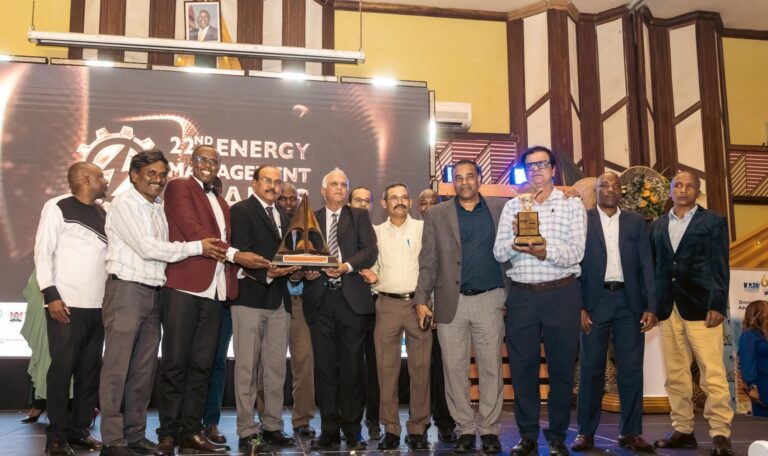
In 2026, KAM hosted the 22nd edition of the Energy Management Awards, which recognise energy efficiency, renewable energy adoption, climate action and sustainable manufacturing.
According to the 2026 EMA assessment, participating companies collectively realised 118,904 gigajoules of thermal energy savings and 6,203 megawatt-hours of electricity savings, worth about Ksh340m. The assessment also recorded progress in digitalisation and renewable energy adoption.
In response to changing industry needs, Alando says, CEEC has widened its scope beyond traditional energy efficiency programmes and now offers technical assistance in resource efficiency, renewable energy adoption, decarbonisation, climate action, sustainability reporting and compliance with emerging environmental and sustainability standards.
The Kenya National Energy Efficiency and Conservation Strategy (KNEECS) identifies CEEC as a critical implementing partner in the country’s energy efficiency and conservation agenda, as industries face rising energy costs and stricter global sustainability requirements.
Alando also sets out what KAM would like the government to do to bring down the cost of business electricity. “What would do this fastest is addressing the cost drivers within the electricity tariff,” he says. The first is removing VAT on the levies charged on fuel, because those costs feed into the cost of power generation and, in turn, manufacturers’ electricity bills.
Second, Alando says, technical and commercial losses should be separated out when electricity tariffs are set, so that manufacturers are not bearing the cost of inefficiencies in the supply chain. Third, KAM wants a review of the 1MW cap on captive power generation, giving manufacturers who are willing and able to invest in their own generation more flexibility and more control over both reliability and energy costs.
Lastly, KAM is calling for electricity tariffs to be streamlined across Special Economic Zones (SEZs) and Export Processing Zones (EPZs), so that manufacturers in different designated industrial zones do not face significant variations in electricity costs. Alando argues that a more harmonised and predictable tariff structure would give manufacturers greater certainty when they plan production costs and make investment decisions, and would strengthen their competitiveness across the zones.
This article was written by Evans Ongwae of Nation Media Group and is published through ENN’s partnership with Nation Media Group.
Images: KAM honours firms leading Kenya’s clean energy transition at the 22nd Energy Management Awards.