
Synergising power and mining: unlocking “added value” as part of the energy transition
Matthew Staff, Freelance Copywriter
The model for mining in many African countries was always clear – extract and ship. But now, there is a paradigm shift. A shift that aligns with the continent’s just energy transition aspirations. A shift that promotes collaboration between countries, sectors, ministers, public decision makers and private entities. A shift that champions the circular economy. And, most importantly, a shift that sees ‘value-add’ as a way to not only power mining, but to power the communities and people around mining.
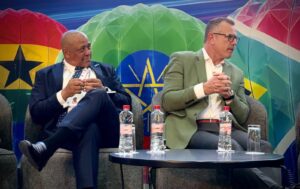
“When you don’t manage your resources to benefit your people you get problems, you get poverty, you get tension, and you get conflict,” asserted H.E. Honourable Julius Daniel Mattai, Minister of Mines & Mineral Resources, Sierra Leone.
This shift of mindset and approach for most countries across Africa, and certainly in Sierra Leone, revolves around an improved synergy between mining and energy, and the search for value addition relative to industrialisation and economic growth ambitions.
The Honourable Minister caveated: “We’re talking about exponential growth in demand for critical minerals, but you first have to find them. We can’t have “value add” on something that hasn’t been found yet. The potential for economic development can only be realised once minerals are extracted. For that you need the right processes, technologies, infrastructure, policies, regulation and collaboration.
“All of this depends on, and revolves around, energy.
“We can talk about industrialisation as much as we like, but electrification is the backbone for any development. We need pride, passion and partnerships to address each of these phases and to meet our ambition.”
Bridging the gap between strategy and investment
Zyed Akram Zitouni, Business Development & Sales VP, Karpowership is bullish about the need for urgency in this continental effort to better power downstream mining capacity in Africa.
He added: “We need to look at how best to collaborate and find synergies where energy production serves not only the mining industry but also neighbourhood communities to reach the ultimate goals that His Excellency talked about.”
But who’s responsible for stimulating this more coordinated effort?
Akram Zitouni continued: “It is crucial that energy is available, reliable and there when we need it. I’ve seen master development plans where the mining investor was waiting for reliable energy to start their refineries, and the utility provider was waiting for them to start their activity to justify the huge investment.”
Karpowership has helped to bridge the gap with solutions that relieve burden and end the standoff from both sides, but hopes to see more responsibility taken from individual countries, just as Democratic Republic of Congo has.
Ngalula Sandrine Mubenga, Board Member, Electricity Regulatory Authority (ARE), Democratic Republic of the Congo explained the success of the country’s three-pronged approach of looking to process minerals locally, of enhancing education among the mining workforce, and of underpinning both with access to clean and sustainable electricity.
“Once we have those three pillars together we can stimulate local transformation of minerals, add value within the energy transition framework, enable job creation, and in due time improve the standard of living for the population,” she said.
The value of collaboration
Very few countries claim to have a perfect plan when it comes to establishing this synergy between mining and energy, but the proactivity and pragmatism shown by many countries, including Sierra Leone and Democratic Republic of Congo, gives reason for optimism.
Akram Zitouni affirmed: “Seeking perfection is the enemy of taking action. We need tailormade solutions. I don’t want to see mining projects waiting for a green light to be developed. I don’t want to see masterplans sitting on shelves for years.
“What prevents a country that has some of the largest mineral reserves from using solutions that already exist, to enable and empower this sector transformation? The financial institutions are available, the regulators are working hard, the political agenda is geared towards industrialisation and the energy transition.
“Everyone needs to work together to make it happen. We shouldn’t be given a hammer and then be told all our problems are nails. It all comes down to collaborative execution.”
With effective collaboration, that notion of “value add” can be put back on the table. More specifically, the need to align the powering of mining with the broader needs of the local region and ultimately the continent as a whole. This would represent a circular economy ethos where shared power supply enhances mine operations for greater industrialisation and economic growth, to further propel the mining sector in perpetuity.
“Africa’s mineral wealth should not only power the mines themselves, but should help to transform the continent,” confirmed Rushaiya Ibrahim-Tanko, Global Policy Director, The Energy for Growth Hub.
A win for mining and a win for humanity
Ibrahim-Tanko’s rallying cry stems from a train of thought that the power to run key national mines and international mining corridors should be structured and managed in a more holistic and collaborative way, where that power and infrastructure is also shared with the wider grid and population.
“Mines can do more than just solve their own energy demands. These private lines behind the grid need to become part of the national system,” she added.
It’s a train of thought starting to be shared by the mining community itself, as epitomised by the work Seriti Resources and its dedicated renewable energy subsidiary, Seriti Green, is doing in South Africa. The company handed over the Vunumoya Main Transmission Station to Eskom in late 2025 to serve as a gateway for 900MW of renewable energy to reach the national grid.
Group CEO, Mike Teke urged: “Africa cannot fail its population as it grows. The GDP of any country or continent correlates with the availability of, and access to, power. If a country has power, GDP growth is guaranteed. Without it, GDP struggles, employment becomes a problem, and there is underdevelopment on the continent.
“Here, we have copper, lithium, cobalt, all these resources – as a continent, we must leverage these projects to generate power for the benefit of humanity, not just for the benefit of mining companies.”
A holistic proposition
Unfortunately, there are still numerous examples across Africa where thriving mining projects are running smoothly upon a backdrop of struggling energy capacity for citizens and stuttering industrialisation efforts. Governments, utilities, power pools and mining companies are now seeking a more holistic symbiotic relationship to change this narrative.
“Mineral extraction should be tied to value addition,” agreed Vincent Nyirenda, Chief Projects Officer, Copperbelt Energy Corporation. “It must lead to industrialisation that benefits the common person… that impacts the life of the ordinary citizen. If there’s no linkage between industrialisation and the person in their ordinary life, then that industrialisation is misplaced.”
He continued: “To work, the pie needs to be made bigger. The bigger the pie, the better the share, and the less you worry about keeping transmission lines or substations for yourself. And when the pie is bigger and partnerships are formed, it’s the common person who benefits, as well as the mine and its shareholders.”
The idea of a just energy transition rings true to this end, with mining sitting at the intersection of both industrial and social agendas when it comes to energy.
There is a consensus that mining-driven power demand can accelerate investments in renewable energy projects, while also planning for an infrastructure that transmits that power to both the mine and the grid as a holistic, renewables-inclusive, proposition.
Gamechanging precedents
“We see the mining sector as a major growth player in terms of South Africa’s energy transition,” stated Sampson Mamphweli, Head of Energy Secretariat, SANEDI, South Africa.
This is a vision shared by compatriot Bradley Reddy, General Manager, Growth Strategy, Richards Bay Minerals, who has seen firsthand how the Rio Tinto subsidiary is approaching power with a green, holistic, value-add mindset.
“It’s been a gamechanger, the country’s liberalisation and policy changes enabling intense energy users and mining houses like us to enter the renewable energy space,” he said.
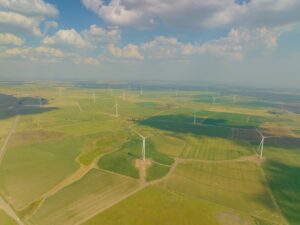
Rio Tinto’s Bolobedu Solar Plant in Limpopo was commissioned in April 2026, and delivers clean energy via the national grid to Rio Tinto’s Richards Bay Minerals (RBM) operations.
It’s one of many similar designs now mobilising across the continent, helping to lower operational costs while also supporting broader industrial development.
The Nzilo II project in Democratic Republic of Congo is a 200MW plant designed to power major mining operations while also stabilising the regional grid. In Guinea, there is a 2040 vision to connect its Simandou iron ore mine to the national grid more concertedly, via the filter of renewables. Powerplants in the country are already being developed with that dual purpose in mind.
And, in Zambia, its 430MW Solar-Wind Hybrid Project is setting the tone for a conversation that merges renewable energy, mining project stability and – critically – grid connectivity as one holistic plan.
Shared infrastructure and shared ambition
“The lessons we’ve learned is that an isolated mining development leads to chaos in the surrounding area,” explained Ephraim Munshifwa, PS, Energy, Ministry of Energy, Zambia. “You can’t just tailor power supply to the mine only. Once the mine is developed, the settlements, towns and region around it also grow.
“You should therefore have the foresight that whatever transmission lines and infrastructure you’re providing to the mine should also be able to provide for that growing community around the mine.
“As a result, the communities benefit from this collaboration between private and public, you avoid the chaos, and there’s no reason that renewable energy sources can’t drive that plan to ensure both mine security and broader energy security.”
Alasdair Martin, Director, Private Customer Solutions, Globeleq notes that a successful link between renewables, mining and national citizens will come down to “bankability, innovation and capability development”. Ticking all three boxes will unlock the required funding, planning and regulatory mechanisms that will build on these positive examples in the years to come.
“The demand is there, but we now need to create an enabling policy environment,” confirmed Mamphweli.
Positivity, proactivity and pragmatism are three Ps now permeating through Africa’s mining sector. Whether it’s policy, funding, collaboration or ideation, there is consensus about what the end goal is.
An end goal where mining is powered effectively using sources that support the continent’s energy transition. An end goal where projects get off the ground quickly thanks to well-structured and designed strategy. And, pivotally, an end goal where powering mining operations goes hand-in-hand with powering communities and citizens through shared infrastructure and ambition.