Minerals need corridors, and corridors cross borders
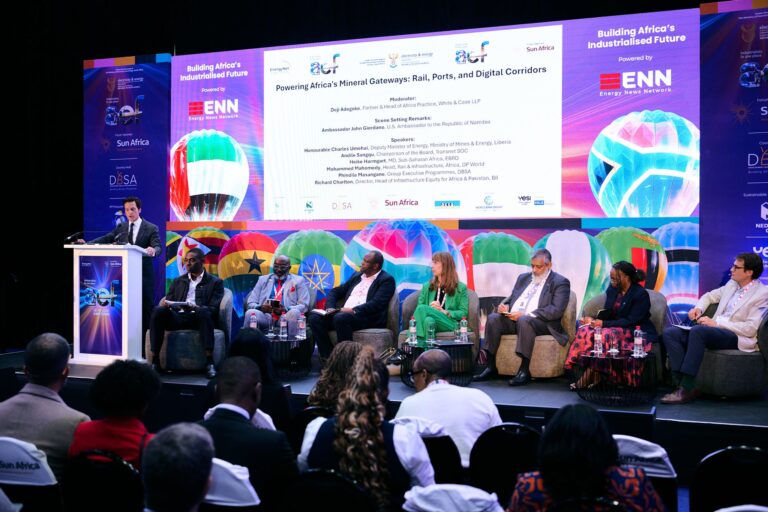
An estimated $8.6 trillion of what lies under African ground is unmined, much of it stranded without the transport and power to move it. At AEF, the Energy for Growth Hub’s Gyude Moore, AFC’s Ziyanda Mpakama and Transnet’s Andile Sangqu set out the case for shared, open-access routes serving more than one mine.
“Currently, it is estimated that we have $8.6 trillion in minerals that have not been mined,” Ziyanda Mpakama of AFC Capital Partners told the Africa Energy Forum. The figure was not offered as a case for more drilling. On the panel’s account the wealth is stranded by infrastructure, ore that cannot reach a buyer for want of a route to market and the power to work it along the way.
For most of a century the answer was built one mine at a time, a private line running from pit to port, engineered for a single commodity and closed to everyone else. Infrastructure of that kind moves ore and nothing more, and the economies it passes through watch it go by. The panel, convened on the forum’s mineral gateways day, made the case for the opposite design, routes built for many users from the start.
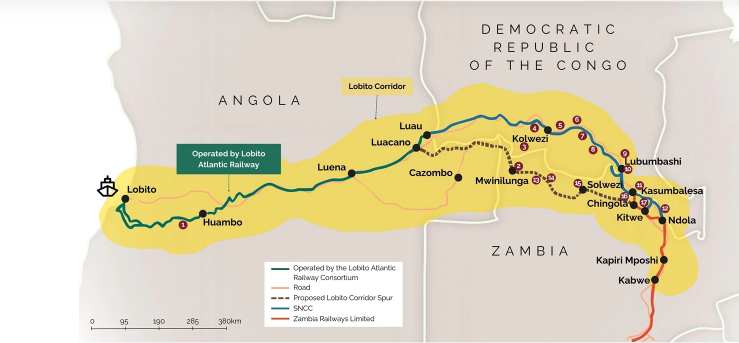
The Lobito Corridor is the test of the newer thinking. The route connects the copper and cobalt of the Democratic Republic of Congo and Zambia to Angola’s Atlantic port of Lobito, and it has drawn backing from Washington and Brussels as well as African lenders. Its design departs from the enclave model on purpose. “The Lobito Corridor was designed in a manner that is integrated and looks at multiple users and multiple commodities. It’s open access,” Mpakama said. A line built for many users is also a line with many revenue streams, which changes what a financier can do with it.
The money, on the panel’s reckoning, will not come from treasuries. “Governments do not have the balance sheets and financial capacity to invest in either the infrastructure projects or mining operations at scale,” said Transnet’s Andile Sangqu. Private capital fills that space only where the asset can pay for itself, and the shared corridor is the version of the asset that can, since freight well beyond the founding mine rides the same rails.
Power runs through the case at every point. A corridor is an electricity customer along its whole length, and the mines and processing plants it serves are larger ones still, demand of the concentrated kind that generation and grid investors increasingly plan around. Industrialisation, the US Ambassador to Namibia argued at the same forum, is a story about connectivity rather than resources, and the beneficiation case made across the minerals sessions rests on the same foundations, since value is added where transport and power allow it to be.
For W. Gyude Moore of the Energy for Growth Hub, the point of all of it is what gathers around the railhead. “The idea now is to allow a mine to be used as an anchor to benefit the wider economy, crowding different projects around it,” he said.