Transmission becomes an asset class
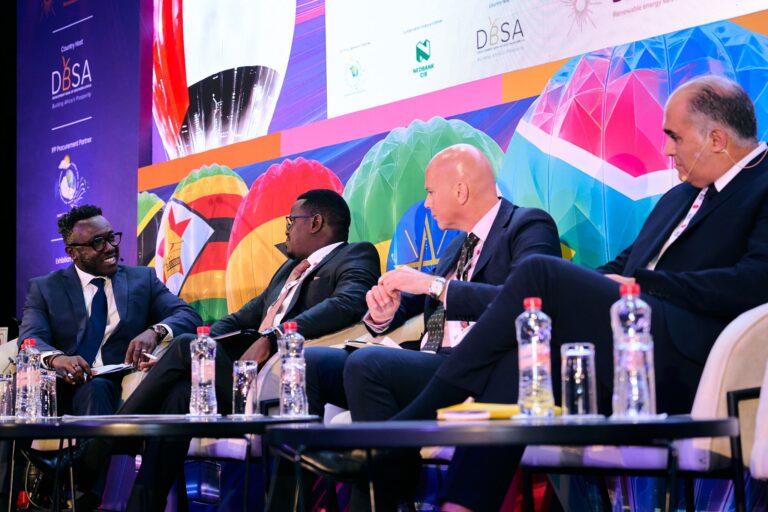
Africa’s new generation is outrunning the lines that carry it, and governments are short of balance sheets to build more. At AEF, Africa50’s Moshood Abolade, Nana Boakye-Yiadom and Nabil Saïmi, with Kenya’s Kefa Seda, set out a privately financed, programmatic model for the grid, proven in Chile, Brazil, India and Peru.
Fifteen to twenty-five cents of every dollar invested in Africa’s energy sector should now go to transmission, Moshood Abolade told the Africa Energy Forum. The investment director at Africa50 was putting a number on a shift the whole panel described, that the wires have overtaken the power stations as the constraint on the continent’s electrification.
The generation pipeline has never been fuller, and the grid to carry it has not kept pace. “There are very huge constraints in terms of transmission to further roll out the energy transition and to decarbonise,” said Robert Voskuilen, who manages eastern and southern Africa energy at the Dutch development bank FMO. Africa50’s Nana Boakye-Yiadom put it in a single line, that transmission remains the critical missing link.
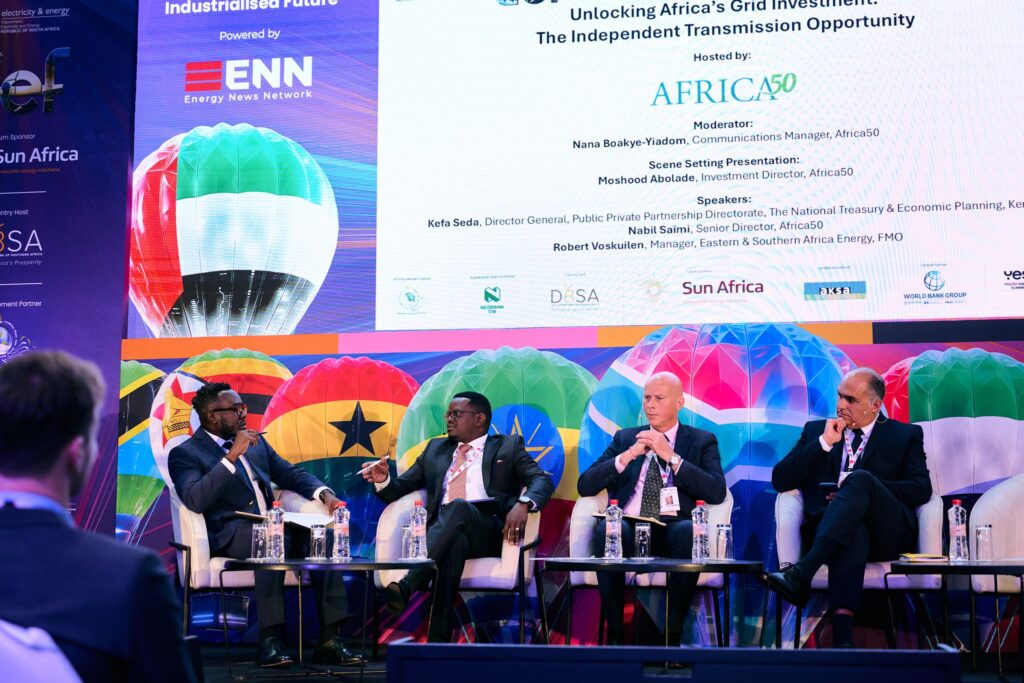
What has changed is that the missing link now comes with a financing structure attached. Abolade set out the model plainly. “It’s a structure where lenders provide the majority of the funding requirement, underpinned by long-term cash flows backed by a 30-year concession agreement, transmission license, and regulated availability-based tariff. It’s bankable and repeatable!”
The precedent is already built on three other continents. “Africa doesn’t have to reinvent the wheel,” Abolade said. “There are success stories in Chile, Brazil, India and Peru who have shown projects can be done at scale by adopting this model and partnering in an efficient way.”
Kenya has become the test of whether the model travels. “Previously, our focus was on generation and distribution, but we had a missing link in transmission. That’s why we’ve taken a bold step as a country,” said Kefa Seda, director general of the public private partnership directorate at Kenya’s Ministry of Treasury and Planning. The step was born of arithmetic as much as ambition. “Our public fiscal space is shrinking, social needs are competing, and we need to find an innovative way to finance and fill this gap.”
The prize the panel described is bigger than any single line. A concession that works once becomes a template, and a template becomes a market that private capital can plan around. For Nabil Saïmi, senior director at Africa50, that is the point the sector has reached. “We should now see a move from project-to-project concepts to more of a template and a programmatic concept,” he said. “The opportunity is there to meet growing access and industrialisation needs.”