
Namibia onshore oil rush accelerates as Kavango West drilling draws institutional capital
ReconAfrica holds licenses covering 13 million contiguous acres across the Kavango Basin, where successful flow testing at the Kavango West 1X well has recorded the first onshore hydrocarbon recovery in Namibian history. The commercial transition pits state-backed financial targets against the protections of the Okavango Delta watershed.
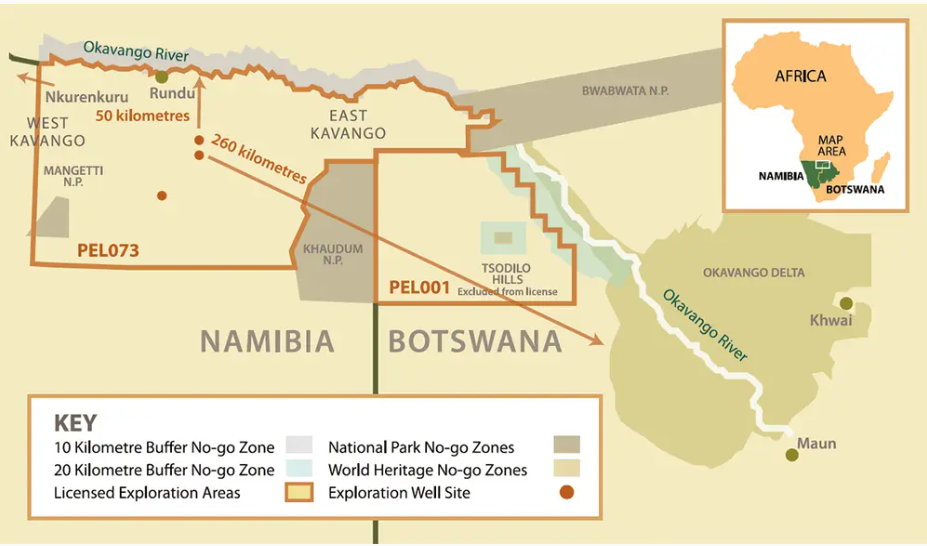
On the Kavango frontier of north-eastern Namibia, a closed C$21.9 million public offering secured the capital runway for an immediate 1,000-metre horizontal sidetrack drilling campaign. The corporate financing follows operations at the Kavango West 1X discovery well, which successfully flowed natural gas and light oil to the surface from the Huttenberg carbonate formations. The drilling campaign forms the baseline of a joint venture between Reconnaissance Energy Africa and the state-owned National Petroleum Corporation of Namibia. Local ministries view the oil-bearing intervals as a critical structural engine, whilst transboundary conservation authorities warn that industrial production threatens the fragile eco-systems feeding the Okavango Delta upstream.
Sovereign rights to resource development dominate the regional political strategy. Namibian Minister of Mines and Energy Tom Alweendo stated that the country must utilise its natural endowments to eliminate poverty and fund industrial infrastructure. The local administration highlights that unemployment in the Kavango East region reaches 39 per cent, making domestic energy production a direct path to employment. State geologists point to the sheer scale of the basin, which spans both Namibia and Botswana, as an asset capable of matching the economic output of recent offshore deepwater discoveries.
The regulatory framework requires navigating complex international environmental treaties. The Permanent Okavango River Basin Water Commission monitors all commercial activity near the river systems, noting that the license area sits within the watershed of the largest un-fragmented wetland on the continent. Environmental analysts from the International Union for Conservation of Nature argue that clearing land for drilling sites, access roads, and processing facilities disrupts migration corridors for the region’s elephant populations. ReconAfrica responded by shifting its seismic testing tracks to existing public roads and utilizing water-based drilling fluids to eliminate chemical seepage risks.
Investment timelines depend on the upcoming cased-hole production testing. Institutional backers require definitive commercial flow rates before committing the capital needed for long-distance pipeline infrastructure. The corporate project plan targets isolating 345 metres of prospective reservoir intervals to map out formal reserve estimates. Government approval hinges on environmental impact assessments submitted to the Ministry of Environment, Forestry and Tourism, creating a legal check that delays the transition from exploration to production.
“We cannot be asked to lock away our assets while our population lacks basic industrial power, but our execution must prove that resource extraction and environmental safety coexist,” Alweendo said.
Images: Yale Environment 360 & dealroom.co