How Gulf investors are driving Africa’s energy transition
Africa needs power, and power demands capital – lots of it. In the past, investment was expected to come from the state, usually supported by borrowed money. But in recent years, a new source of capital has emerged in the form of commercial investors who see an opportunity in Africa’s drive to build renewable energy capacity. Today, some of the most active are state-backed investment and development vehicles from Gulf countries, including the UAE, Saudi Arabia and Qatar – and they’re changing the shape of Africa’s energy transition.
Every year since 2008, Abu Dhabi Sustainability Week has brought together world leaders and investors in sustainable and renewable power technologies. This year was the biggest event yet, but at January’s opening ceremony one thing stood out: African leaders were there in force. In attendance were the heads of state of the Central African Republic, Madagascar, Mozambique and Senegal, along with the presidents of sub-Saharan Africa’s two largest economies: Nigeria and South Africa. It was a reminder that when it comes to finding partners to speed their energy transition, Africa’s leaders have their sights set firmly on the Gulf.
Some might say the connection was inevitable. Africa has more than half a billion people without access to reliable electricity , and its leaders recognise that renewable power is the cheapest, fastest way to plug the energy gap. For their part, Gulf states have vast capital resources, coupled with a strong desire to diversify away from fossil fuels and invest in new technologies, including renewables.
The rise of renewables
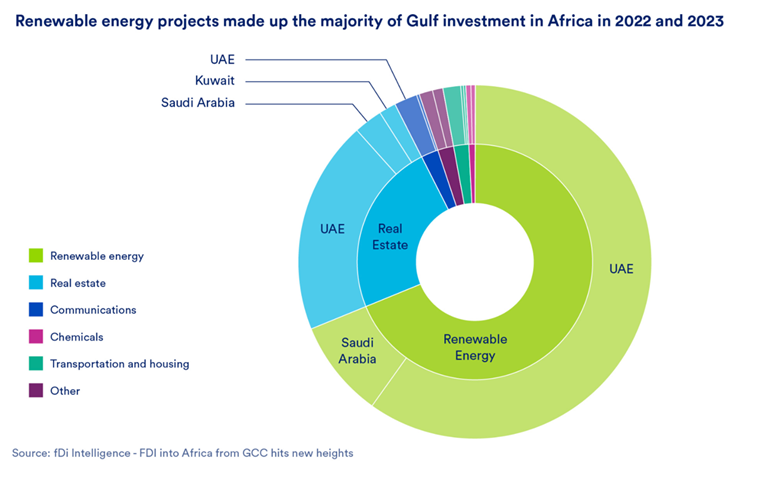
Africa has been the recipient of a growing flow of foreign direct investment from Gulf Cooperation Council (GCC) countries over the past decade and a half. According to the Clean Air Task Force (an independent US-based energy policy institute), GCC countries invested more than $100 billion in Africa during 2012-22 , and over the past few years this investment flow has been predominantly in clean energy.
“The drivers of this investment are strategic before they’re financial,” says Monie Captan, deputy CEO – West Africa at Petrodex, a Dubai-based integrated energy platform active across power trading, generation, and related infrastructure development in Africa. “Gulf states are engaged in a deliberate campaign to deepen their economic and geopolitical footprint across the Global South, and Africa is one of the most important theatres for that. Cultural and religious ties across West Africa, the Sahel and East Africa give GCC players an edge – and energy infrastructure is one of the most effective ways to translate that trust into long-term economic partnerships.” As an independent private-sector operator, Petrodex complements these larger capital flows by bringing commercial structuring capability, regional relationships and on-the-ground execution capacity in the African markets where it is active.
Behind this flow of GCC capital stands the region’s sovereign wealth funds, which are emerging as primary drivers of clean energy investment in Africa. The four biggest GCC investors in the sector are: Masdar, the Abu Dhabi state-owned clean energy company with shareholdings split between various state entities (including the sovereign wealth fund Mubadala); ACWA Power, which is 50 per cent owned by the Public Investment Fund (PIF), the Saudi sovereign wealth fund; the Qatar Investment Authority (QIA), wholly owned by the State of Qatar; and AMEA Power, a Dubai-based private company with investment from Japan’s SoftBank.
The UAE leads
According to the Clean Energy Task Force, Masdar is the most active investor and between 2022 and 2024, UAE state-backed entities announced 18 multi-billion-dollar projects in Africa. Masdar alone has committed $10 billion to deliver 10 gigawatts (GW) of renewable capacity in sub-Saharan Africa by 2030, including large-scale solar and wind projects in Angola, Zambia and Ethiopia. Adding to this, Infinity Power (a joint venture between Egypt’s Infinity and UAE’s Masdar) is now the largest African pure-play renewable energy provider. It has a substantial operational portfolio of 1.3 GW across Egypt, South Africa and Senegal – helping to avoid 3.3 million tonnes of CO₂ emissions annually – and a pipeline of 16 GW, including around 3 GW in advanced development.
Meanwhile the QIA has recently pledged to invest a massive $103 billion across six African nations , much of which targets renewable-linked infrastructure and critical minerals, and the Saudi PIF is managing a $10 billion global hydrogen and green energy portfolio alongside its stake in ACWA Power, which currently has a $7 billion portfolio of investments in African renewables with solar and wind projects in Morocco, Egypt and South Africa.
Across all these investments two important shifts have emerged. One is the increased size of renewable projects in Africa, moving from small-scale pilots of 10-20 MW to gigawatt-scale utility projects. The other shift is the expansion of investment beyond North Africa into the large economies of sub-Saharan Africa – the biggest beneficiaries so far being South Africa and Kenya. According to Bloomberg, African clean energy investment is still overwhelmingly concentrated in these two countries, alongside Egypt and Morocco.
According to Ahmed Mulla, deputy CEO of Infinity Power, the keys to attracting Gulf investors to any sub-Saharan African countries are finance and regulation. “The success factors in a new African market are the ability to raise non-recourse finance and the regulatory framework – you need a strong mandate from the authorities to pursue renewable energy projects. You also need a reason to believe that renewables have scalability in the market – we don’t want to do one project then find we can’t do any more.”
Risk and return
It remains to be seen whether the flow of Gulf investment to African renewables will expand in countries that have so far been largely off the investment radar. Captan, of Dubai’s Petrodex, thinks that’s likely. “Projects that get the structure of financing right in sub-Saharan Africa can generate very attractive risk-adjusted returns,” he says. But he cautions: “The discipline required to structure and deliver them is considerably higher than in more developed markets, and that is precisely where experience on the ground makes the difference.”
Mulla agrees: “The key component is having a credible partner who’s African, dedicated to the continent and with boots on the ground. As the African proverb goes, if you want to walk fast, walk alone; if you want to walk far, walk with a group.”
The journey towards a future of sustainable energy security in Africa is long – the most recent figures suggest that so far only two per cent of the world’s clean energy spending has gone to Africa . Will more GCC investors show they’re committed to the long march to an African clean energy future? By the end of 2026, that may become clearer.