Sahel power interconnection begins as Mauritania breaks ground on the first 184km
Contracts signed in April cover a 114km section from Kiffa to Tintane and a 70km extension to Aioun, the first construction under a 1,373km scheme running to 2030. The African Development Fund has committed $302.9 million towards an estimated $888 million cost.
The African Development Bank has confirmed the signing of three project implementation contracts with the Manantali Energy Management Company, known as SOGEM, clearing the way for construction to begin on the 225kV interconnection between Mauritania and Mali. The contracts were signed in April by SOGEM’s chief executive Julien Charles Bernard Sagna and the contracting companies, at a ceremony attended by Mauritania’s Minister of Energy and Petroleum Mohamed Ould Khaled, Minister of Economic Affairs and Development Abdallah Ould Souleymane Cheikh Sidiya, and Malinne Blomberg, the Bank’s country manager for Mauritania.
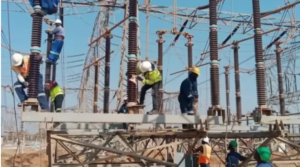
What they cover is a 184km stretch inside Mauritania rather than the full corridor. Two of the three are construction contracts, the first for a 114km 225kV double-circuit line between Kiffa and Tintane, the second for a 70km extension from Tintane to Aioun that reinforces the national grid and extends supply into underserved areas. The third contract covers supervision and monitoring.
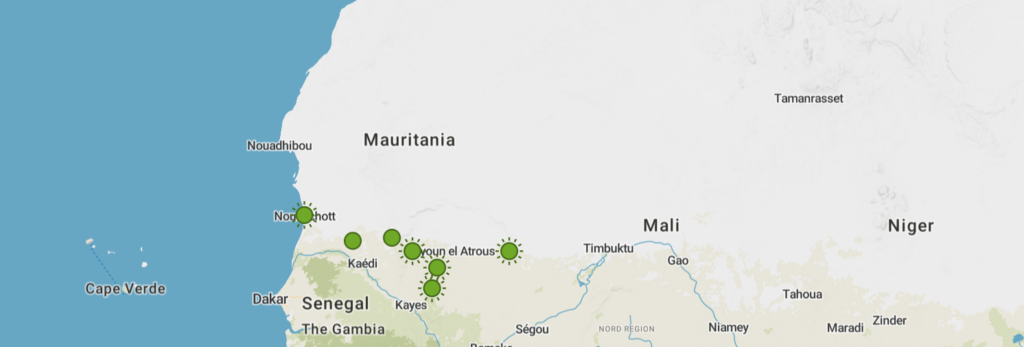
The scheme they sit within, known as PIEMM, runs to 1,373km with 600MW of transfer capacity between the two countries, alongside a 50MW solar plant at Kiffa connected directly into the interconnection. Implementation is planned over seven years, from January 2024 to December 2030.
The Bank expects the programme to reach around 2.2 million people in Mauritania, 52 per cent of them women, and to connect 100,000 new households along the route, 80,000 in Mauritania across 150 agro-pastoral localities and 20,000 in Mali.
Project cost is estimated at $888 million. The African Development Fund, the Bank’s concessional window, approved $302.9 million in loan co-financing, split as $269.6 million for Mauritania and $33.3 million for Mali, with climate funds and other partners covering the balance. It forms part of Desert to Power, launched in 2019 to develop 10GW of solar capacity across eleven Sahel countries from Senegal to Djibouti, and counts towards Mission 300.
The delivery vehicle is worth a second look. SOGEM was created by the member states of the Senegal River Basin Development Organization to run the Manantali hydropower scheme, and has since built rural electrification projects across Mali, Senegal and Mauritania. The entity constructing a cross-border electricity corridor is a river basin authority rather than either national utility, which is a quieter answer to the question of who builds regional infrastructure than the one usually given.