EXCLUSIVE: UNEP offers grants of up to US$1 million to ease energy demand through sustainable cooling
United Nations Environment Programme’s (UNEP) call for proposals on sustainable cooling in Brazil, Ethiopia, Kenya, Morocco and Tunisia is open until 31 October. Grants from $200,000 to $1 million are available with 20% co-financing. The programme forms part of the drive to turn commitments made under the Global Cooling Pledge into practical action, a priority reinforced at the recent Global Cooling Pledge Assembly 2026 in Singapore
As governments grapple with rising temperatures, sustainable cooling is rapidly emerging as one of the most important challenges in the energy transition.
According to Parimita Mohanty, technical lead for the UNEP-funded EPIC Deploy (Enabling Pledge Implementation for Cooling) programme, Cooling accounts for around 20% of global electricity use, and demand is set to triple by 2050 due to climate change and rising temperatures. This would mean that CO2 emissions could double by 2050 (IEA, 2018), placing it first or second within the whole energy mix in several of them. Another major challenge for power engineers, she says, is addressing the severe coincident peak load spikes driven by inefficient cooling infrastructure and determining how best to flatten the curve.
Global demand for cooling is expected to accelerate sharply as temperatures rise and extreme heat becomes an increasing threat to public health, food security and energy systems. At the recent Global Cooling Pledge Assembly 2026 in Singapore, governments and industry leaders highlighted sustainable cooling as a key tool for building heat resilience and strengthen energy security while avoiding a surge in emissions. EPIC Deploy is one response to that challenge. It grew out of the Global Cooling Pledge signed by over 63 countries at COP28 in Dubai who committed to improving access to cooling, raising efficiency and reducing demand, with Italy among them. Today, the Global Cooling Pledge counts 73 national signatories, alongside over 80 subnational governments, cities, and non-state supporters (Cool Coalition, 2025).
Translating high-level commitments into tangible implementation needs policy, regulation and institutional capacity alongside operational, on-the-ground pilot projects.
Two segments carry that proof. The tertiary sector, meaning hospitals, schools and universities where extreme heat reaches children and patients. And the food supply cold chain, where roughly one third of food is lost globally, with 12% of food being lost for want of cold chain infrastructure (UNEP, FAO, 2022).
Grants run from $200,000 to $1 million against a minimum 20% co-financing from the applying consortium, which may be in kind rather than cash but must be itemized in the budget. The valuation methodology should be clearly explained and appropriate supporting documentation retained, and the programme provides a template budget for applicants to submit alongside their application.
Applications come only from consortia, and the programme requires local presence in one of the five countries. Mohanty’s own test runs viability, scalability, how many people a project reaches, and whether it leaves enough local institutional capacity behind the country to carry it on. Research and development alone do not qualify.
Rossella Rubini, who manages the call, advises candidates to focus their application on innovativeness in a real-world setting, its potential for scalability, and its impact.
She encourages interested candidates to download and complete the provided Application Form and Budget templates, ensuring that they remain within the specified word limits. She also stresses the importance of supporting any claims of agreements with consortium partners, local authorities or government ministries with documentary evidence, such as a Memorandum of Understanding or a Letter of Intent. Finally, applicants should clearly identify the type of intervention they are proposing. Type 1, covering hospitals, schools and other public buildings, or Type 2, focusing on food value chains, logistics and ports.
Rubini expects a surge in submissions during the final weeks of October, as is usually the case, and would rather applicants take the time to develop strong, well-thought and genuinely impactful proposals.
As the UNEP Cool Coalition and countries participating in the Global Cooling Pledge shift their focus from commitments to implementation following the Singapore Assembly, programmes such as EPIC Deploy are expected to play an increasingly important role in demonstrating what sustainable cooling looks like in practice.
What the programme wants to see is the difference the project would make to the local community, the power grid, the quality of cooling, the amount of agricultural produce saved from spoilage, the number of children protected from extreme heat in schools, and the number of vaccines preserved in hospital cold rooms.
Applications close on 31 October. Download the application package and find out more at https://epic-deploy.energy-base.org/
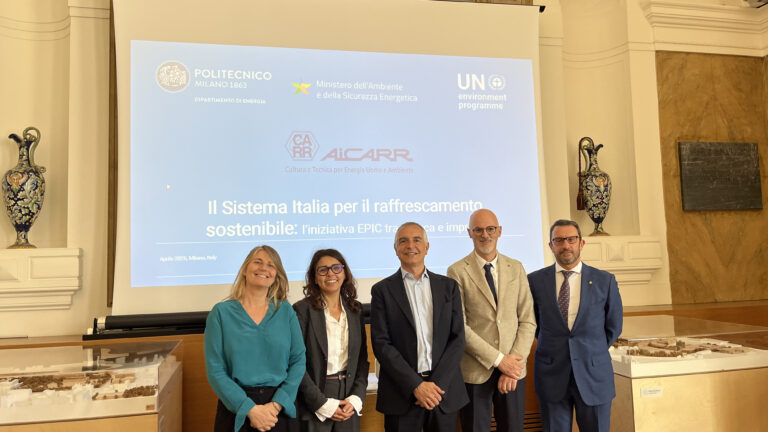
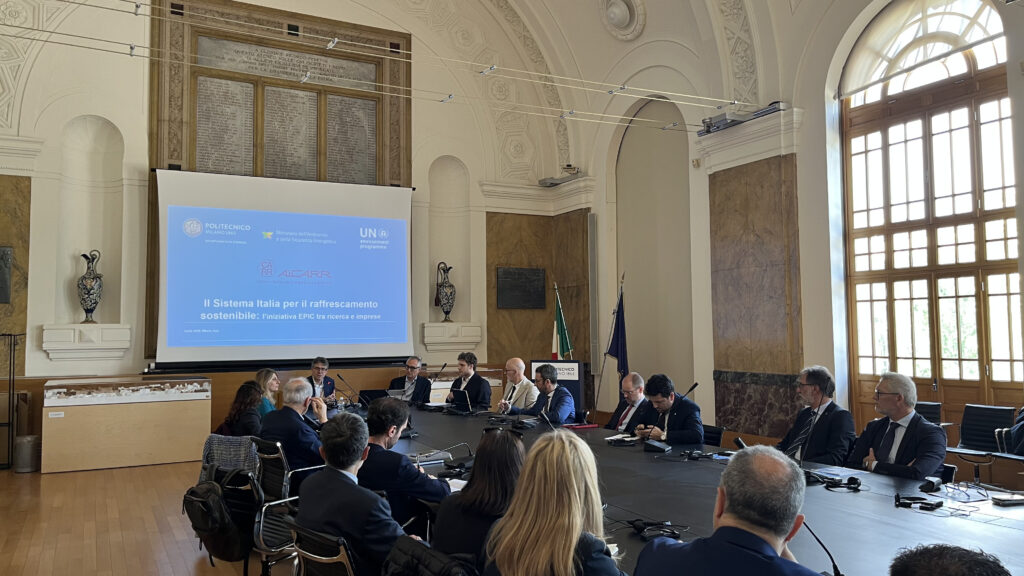
EPIC Deploy is an initiative launched and funded by the Italian Ministry of Environment and Energy Security (MASE), in collaboration with the United Nations Environment Programme (UNEP).
References:
International Energy Agency. (2018). The Future of Cooling: Opportunities for energy-efficient air conditioning. IEA. https://www.iea.org/reports/the-future-of-cooling
Cool Coalition. (2025, 18 novembre). COP30 ministerial dialogue: Delivering on the global cooling pledge. https://coolcoalition.org/events/cop30-ministerial-dialogue-delivering-global-cooling-pledge United Nations Environment Programme. (2022, 12 novembre). Amid food and climate crises, investing in sustainable food cold chains crucial. https://www.unep.org/news-and-stories/press-release/amid-food-and-climate-crises-investing-sustainable-food-cold-chains