Momentum gathers for Madagascar’s 127MW Volobe hydro
Madagascar’s largest-ever power project is moving towards financial close, with development finance lining up behind it. Writing for African Energy, Marc Howard reports on the 127MW Volobe hydro scheme and what it means for a country looking to end its reliance on imported fuel.
Issue 544 – 18 Jun 2026 – By Marc Howard | 7 minute read
The 127MW Volobe hydroelectric power (HEP) project is nearing significant financing and tendering milestones, with electromechanical works being tendered and financing from development finance institutions (DFIs) – including the World Bank Group (WBG) and African Development Bank (AfDB) – falling into place.
Madagascar’s largest-ever power development, Volobe is vital to meeting the government’s goal of adding more renewable energy (RE) capacity to end the microcontinent’s longstanding reliance upon dirty and expensive fossil fuel-powered generation. It is thought that Volobe will save the government over $100m/yr.
Speaking to African Energy at the Africa Energy Forum, held in Cape Town on 16-18 June, Compagnie Générale d’Hydroélectricité de Volobe (CGHV) chief executive Rémy Huber said that financial close is planned for H2 2027, construction for 2028, and commissioning for 2031.
Last year, hydro specialist EDF took a 37.5% CGHV stake, joining Malagasy IPP Axian (also 37.5%) and Casablanca-headquartered infrastructure investor Africa50 (25%); at financial close project backer the WBG’s International Finance Corporation (IFC) will take 7.5% and the government up to 20% (AE 544, 525).
A new series of environmental and social, hydrological, and geological studies have been completed to enhance bankability and derisk Volobe, as DFIs line up to fund the RE play.
The IFC is acting as mandated lead arranger and while other lenders are yet to be formally confirmed, it is likely that the AfDB will provide concessional debt, with the European Union/European Investment Bank (EIB) expected to provide a grant of up to €40m. The WBG’s Multilateral Investment Guarantee Agency (Miga) is set to provide a partial risk guarantee sufficient to cover around six months of cashflow.
Huber said that Volobe “has good momentum – this is a project really needed and wanted by the population and the local and national government.” The widespread support for Volobe is not hard to understand, given that it will displace polluting heavy fuel oil (HFO)-fired thermal generation, which accounts for 60% of energy dispatched to utility Jiro sy Rany Malagasy (Jirama)’s grid.
This fuel is all imported – at huge expense. The bill, typically some $600-800m/yr and likely to be much higher this year, is an enormous cost for Madagascar, the world’s fifth-poorest country in GDP per capita terms (AE 541, 486).
This has a knock-on impact upon the electricity supply industry (ESI) value chain; according to the International Monetary Fund (IMF), Jirama’s average cost of generation is $0.26/kWh, of which over half comprises fuel expenses. The cost of purchasing imported HFO is one of the historic factors that have made Jirama effectively unbankable.
Power is particularly politically salient in Madagascar, where last year’s ‘Gen Z’ protests against corruption and electricity outages led to the October ousting of then-president Andry Rajoelina.
Expected to produce 750GWh/yr, Volobe will also contribute significantly to meeting the government’s Mission 300 (M300) goal of boosting electricity access from today’s 39% to 80%. Upon commissioning, Volobe will provide some 35% of on-grid supply.
Moving towards construction
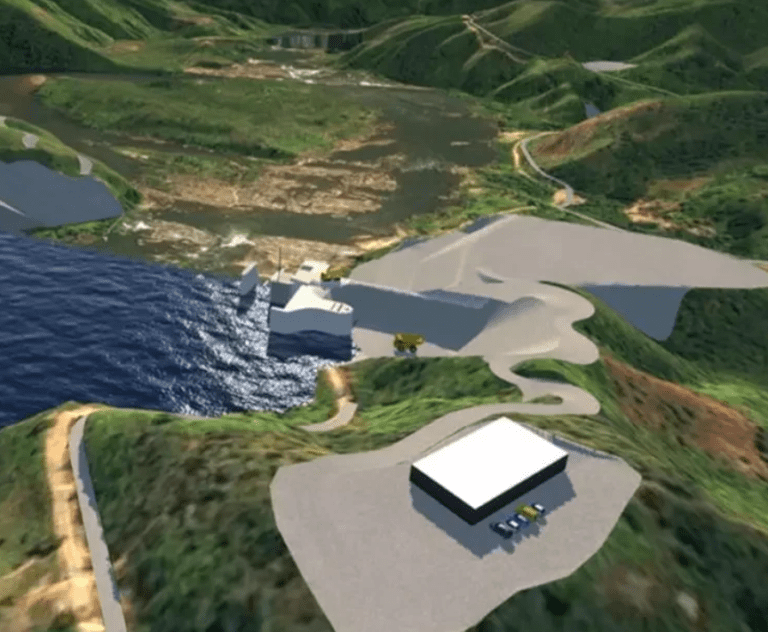
Huber said that the recently-completed studies saw Volobe’s installed capacity increased by 7MW to 127MW. Sited on the Ivondro River, the run-of-river plant will use six Francis turbines and includes a small, 10m m3 reservoir. This will allow four-to-six hours of full capacity dispatch to the Jirama grid, likely during peak demand hours in the dry season.
Early procurement started last year, with three lots of works planned to be tendered:
• Civil works, with the two bidders likely to be China’s Sinohydro and France’s Bouygues Colas;
• Transmission, with the two likely bidders Sinohydro and France’s Vinci;
• Electro-mechanical, for which the bidding process started last month, with the two bidders being Austria’s Andritz and a JV of Germany’s Voith and Spain’s Elecnor.
The processes for the civil and transmission works will start soon – although not immediately – Huber said, adding that it is possible that the civil works will be merged into the electro-mechanical lot.
“The objective is the best price with the best contractors” which will result in a low tariff, benefitting “the people, the utility, and the project,” Huber said, while stressing that while cost is important, the quality of the work would be just as much of an assessment factor.
CGHV is targeting a cost of generation sufficiently below Jirama’s retail tariff to allow the utility, which will offtake under a 35-year PPA, to make a good margin. HEP tariffs are not as cheap as a decade ago, Huber said, given that the high inflation of recent years has significantly increased all of the fixed costs incurred when building large infrastructure.
CGHV is negotiating with the government for VAT and customs duty exemptions during the construction phase to help drive down its costs. A ‘fiscal roadmap’ is expected to be completed by month-end. CGHV and the Ministry of Energy (MoE) are also exploring additional grant funding options to lower costs.
At the local level, CGHV community projects, land acquisition and biodiversity initiatives were underway. There is a very strong emphasis on the ‘social licence’ of Volobe, Huber said, given that it could well operate for many decades beyond its initial 35-year concession. For the local community, Volobe will provide significant concomitant benefits, not least a new 40km road.
This, for the first time, will make the national road network available to the 80,000 residents of Atsinanana, who today must travel 30km on foot to regional economic hub Tamatave, Madagascar’s second city. The new transport link will open up new routes to markets for farmers. CGHV has also purchased a new barge to move equipment and plant across the Ivondro River, which is also utilised by the local community.
The national government is supportive of the project, Huber said, with CGHV having recently twice met with interim leader Colonel Michael Randrianirina, who seized power from Rajoelina in October (AE 533). Randrianirina has pledged to hold free and fair elections by end-2027, and it is thought that his government is intent upon showing tangible progress in power procurement prior to then.
Volobe will provide power to regional economic hub Toamasina (also called Tamatave), Madagascar’s second city and the location of Madagascar’s principal port. A Japan International Cooperation Agency (Jica)-funded rehabilitation of the port is underway, but there is insufficient generation capacity to power both the port and city. Making more electricity available to the port is a high priority for Antananarivo.
A new 380km, 220kV transmission line is also being developed by Jirama, which will run from Tamatave to Antananarivo – interconnecting the previously isolated Jirama grids. Financed by the AfDB (which agreed a €36m loan in 2021), EIB (€81m loan, also agreed in 2021) and Exim Bank of Korea (KEXIM, €40m loan, also 2021), the 120MW capacity, double-circuit line is essential for evacuating all of Volobe’s production, of which only 40MW is required by Tamatave and other local offtakers. The line is being built as part of the AfDB-backed Power Transmission Network Reinforcement and Interconnection Project in Madagascar (PRIRTEM), which will also fund four substations along the route.
PRIRTEM’s new HV transmission capacity is also necessary to dispatch power from Madagascar’s other major HEP development, the 64MW Ranomafana in Anamalanga, 90km north-west of Antananarivo, being built by Sinohydro. In 2024, the Export-Import Bank of China (China Eximbank) agreed a $240m loan for the state-owned project, which is expected to dispatch around 250GWh/yr (AE 486). A Ranomafana groundbreaking ceremony was held in December 2024.
The two new HEP projects are expected to facilitate the addition of as much as 500MWp of new on-grid solar PV capacity, with battery energy storage system (Bess) capacity, under M300. One of the first new developments is a 50MWp/25MWh solar-Bess plant being developed by the UAE’s Global South Utilities (GSU) in Moramanga, 75km east of Antananarivo (AE 529).
Elsewhere, the WBG is also supporting Jirama to reduce its very high level of technical and commercial losses across its transmission and distribution (T&D) network, which run as high as 30%.