Energy Transition Challenge Fund’s David Arinze on Nigeria’s $410 billion misreading
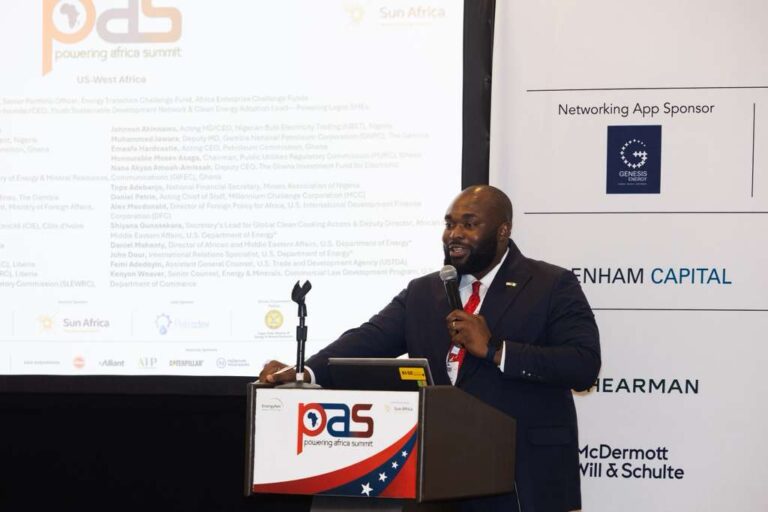
David Arinze of the Energy Transition Challenge Fund, who also leads the Nigeria Economic Summit Group’s Renewable Energy Thematic Working Group, on why the figure everyone quotes is misread, what a solar factory importing its own glass reveals about Nigerian manufacturing, and where catalytic capital stops working.
A solar manufacturer assembling panels in Nigeria imports its glass, and imports the silicon wafers with it. Speaking to ENN, David Arinze says he asked the company why, and the answer had nothing to do with capability. Nigerian glassmakers have no reason to buy equipment that cuts glass to that type and size, because the orders would never fill it.
Twenty more companies asking for the same product and the arithmetic changes. The example carries his argument, that Nigeria’s energy transition is an industrial question before it is an environmental one.
Nigeria’s Energy Transition Plan carries an estimated $410 billion requirement to 2060, and Arinze thinks the number is routinely misread. “This is not just a $410 billion cheque that Nigeria needs,” he says. It is additional investment above a business-as-usual pathway across nearly four decades, and reading it as a bill makes the task look impossible before anyone starts.
Set against the government’s $1 trillion economy ambition, he does not accept that the two compete for the same capital. Nigeria cannot reach that size without more reliable power reaching households and productive sectors, and the transition is harder to finance without an economy generating jobs, taxes and bankable demand.
The industrial case rests on demand that is predictable. A factory running machinery for twelve hours carries a different load profile from a household using appliances in the evening, and that profile improves asset utilisation across generation, mini-grids and commercial and industrial projects. He points to the Nigeria Economic Summit Group’s 2026 private sector outlook, which still identifies high energy costs as a limit on firm-level productivity.
None of it holds automatically. Industrialisation without corresponding renewable investment breaks the relationship, as does transition policy that raises the cost of energy without solving reliability. Currency is the sharpest fault line. “You can have an excellent project technically and still have an unbankable project financially because of currency mismatch,” he says, describing equipment and financing priced in dollars against businesses earning naira.
Before catalytic capital arrives, he describes companies with demand, technology and capable teams deciding each month which single constraint to address. Within six months of funding they can buy equipment at a scale that changes their economics, hold inventory instead of losing customers between shipments, and enter markets they had priced as too risky.
The money arrives with conditions, and he calls that guided finance. Due diligence, milestones, reporting obligations and stronger financial discipline come attached to it. “You are simply not giving a company money. You are helping the company make that enterprise more investable,” he says. The aim is the point at which commercial capital becomes comfortable. “We don’t leave the companies the same way we met them.”
Asked what companies get wrong, he reframes it as what makes a business investable. Strong technology can sit alongside a weaker business model where the founders came from engineering. Working capital, after-sales and foreign exchange exposure are often underestimated by companies that know their product thoroughly. Governance concentrated in a single owner carries a risk any financier will price. Landing a yes, in his account, becomes fairly predictable once a business has addressed the fundamentals of viability.
Finance cannot stabilise a macroeconomic environment, remove currency volatility, build transmission or train technicians. It cannot substitute for predictable regulation, effective institutions or security, and it cannot manufacture demand where customers cannot afford the product.
The fund was established by the German and Nigerian governments, financed through KfW and implemented by the Africa Enterprise Challenge Fund. He describes it as complementary to conventional development finance, not a replacement. Development finance institutions need companies able to absorb debt or equity at scale. Catalytic grant capital works earlier on the same continuum, close enough to diagnose the company itself.
The difference between the private sector and government is not over whether Nigeria should transition. It is over who carries the cost, who carries the risk and how fast reform moves. The private sector wants predictability on tariffs, licensing, grid access and returns. “Energy is a business and it must be paid for. It is not a charity.” Government weighs affordability, access, employment and the political consequences of energy prices at the same time.
He calls the decentralisation created by the Electricity Act of 2023 an incredible initiative. ENN reported this month that NERC has transferred regulatory oversight to sixteen subnational commissions. What he wants beside it is coordination, so that thirty-six states and the Federal Capital Territory become, in his phrase, thirty-six laboratories for innovation and not multiple layers of regulatory uncertainty.
In Abuja in November he would put the financial architecture ahead of the size of the announcements. Many renewable projects are individually too small for institutional investors, so he asks whether they can be aggregated into portfolios, whether concessional capital can absorb first loss, whether local pension capital can participate at greater scale, and whether refinancing mechanisms can let developers recycle capital into the next project.
“What must change,” he asks, “so that much more of the capital already looking for opportunities in Africa can actually invest in Nigeria at scale?”