
Exclusive: Copperbelt Energy on building 136MW of solar without a sovereign guarantee
Owen Silavwe, Managing Director of Copperbelt Energy Corporation, on financing Zambia’s largest solar plant through CEC’s own green bond and on the cross-border trade it sees with the DRC, as the company hosts investors in Livingstone as Country Host of the Zimbabwe-Zambia Energy Projects Summit.
Copperbelt Energy Corporation (CEC) now runs 242MW of solar in Zambia, led by the 136MW Itimpi II plant it financed through its own green bond, and it is Country Host of the Zimbabwe-Zambia Energy Projects Summit in Livingstone from 3 to 5 November. Its Managing Director, Owen Silavwe, answered ENN’s questions ahead of the summit.
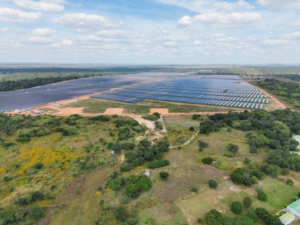
Itimpi II is Zambia’s largest solar plant at 136MW, and CEC financed it through its own green bond rather than on a sovereign guarantee. What did that route make possible, and could others in the region follow it?
The funding and development of the 136MW Itimpi II plant has demonstrated how large-scale energy infrastructure projects in Africa can be financed through capital markets without relying on any form of sovereign guarantees. It has further illustrated the possibility for well-structured, commercially viable renewable energy projects to access private capital, and it is replicable in other regions.
A key learning is that bankability, credible sponsors, strong project fundamentals, appropriate risk allocation and supporting green financing frameworks can unlock alternative pathways for funding similar assets in the region.
How close is CEC to its target of 500MW by 2027, and which projects will take it there?
CEC has already reached 242MW of installed solar generation capacity, delivered through the 34MW Riverside Solar Plant, the 60MW Itimpi I Solar Plant, the 12MW Fitula Solar Plant and the recently commissioned 136MW Itimpi II Solar Plant. The projects that will take us there are at various stages of development at locations within Zambia. Among these projects is the Garneton 25MW Solar Project, under the GET FiT Zambia programme.
Zambia is aiming for three million tonnes of copper a year by 2031. How is rising demand from the mines changing the way CEC plans its generation and network?
The mining sector remains the backbone of Zambia’s economy, generating approximately 70% of the nation’s foreign exchange receipts. It is our expectation that demand for power from the mines to meet the target of 3 million tonnes will increase to align with increased activity and production. We further recognise that this production will be underpinned by one critical enabler, which is the provision of reliable, adequate and affordable energy.
We are responding by continually building and managing a robust power supply portfolio, consisting of own and third-party sources, representing a mix of technologies such as hydro, solar and thermal, to ultimately deliver an energy mix designed to meet dynamic customer demand profiles. Beyond this, we continue to invest in transmission infrastructure and regional interconnections to deliver reliable, scalable and diversified power solutions for existing and future mining operations.
CEC also sells power into the DRC. Where do you see the opportunity in cross-border trade over the next few years?
The Democratic Republic of Congo (DRC) represents one of the most attractive growth opportunities in the regional power market, particularly given continued expansion of mining activity in the Copperbelt and Katanga regions. CEC already supplies power to mining customers in the DRC through our subsidiary CEC-DRC.
Looking ahead, we see significant opportunities in the DRC, and it is for this reason that we are actively looking towards expanding transmission infrastructure between Zambia and the DRC to increase cross-border transfer capacity, enhance system reliability and support the growing energy needs of customers on both sides of the border.
As Country Host of the Zimbabwe-Zambia Energy Projects Summit, what would you most like investors in Livingstone to understand about Zambia’s power market?
One thing we would like investors to know is that there are increasing opportunities within Zambia’s power market. The Government has set an ambitious target to achieve approximately 10GW of installed capacity by 2031. This in itself signals the opportunities for investment across the power value chain, particularly in generation, transmission and distribution infrastructure.
To attract private sector participation, the Zambian Government has introduced progressive energy reforms, particularly the country’s open-access framework. Coupled with a stable mining sector, abundant renewable energy resources and strong government support for energy sector growth, Zambia offers investors a transparent and expanding energy market with substantial long-term opportunities.