
Why Zambia is like the ‘belle of the ball’ among energy investors
By Bwalya Chilufya-Musonda, Partner, Bowmans Zambia
Bwalya Chilufya-Musonda, Partner at Bowmans Zambia, on why private investors are turning to Zambia’s power sector, as the National Energy Compact sets out $11.9bn of generation and transmission investment to 2030, with $9.5bn expected from the private sector and installed capacity planned to more than double to 10,000MW.
Despite recent climate challenges, which highlighted an overreliance on hydropower, Zambia is emerging as the ‘belle of the ball’ for private sector energy investors. The country is in an enviable position to attract the investments it needs to overcome its energy deficit.
Zambia’s energy plans are set out in the National Energy Compact for Zambia, which aims to completely transform the energy sector by 2030.
Private-sector funding is central to new generation and transmission projects, which require a total investment of $11.9bn in the four years to 2030. Some $9.5bn of this should come from private-sector actors, according to the National Compact, mainly for generation, transmission and off-grid projects. Overall installed generation capacity is set to more than double to 10,000MW, and 90% of this will be privately funded.
Private funding will also play a major role in expanding the transmission network from 12,705km of lines to 17,913km. Here, the investment ratio is expected to be 70/30 for private versus publicly sourced funding.
Projects involving distribution, on-grid access, last-mile connection and clean-cooking access will draw predominantly on publicly sourced funding. The targets here are to provide 100% electricity access for citizens, compared with slightly over half currently, and to expand clean-cooking access from around 4% of households to 40%.
Operational
Hydropower has long dominated Zambia’s energy sector, accounting for 83% of installed generation capacity. This overexposure was starkly highlighted as a systemic vulnerability by the drought of 2023 and 2024, when the Kariba hydro project fell to 10% of its capacity.
The result was load-shedding so severe that Zambians were lucky to have as little as three hours of power a day.
While non-hydro renewables currently make up only 3% of energy sources in Zambia, this is set to increase to 33% by 2030. Solar will make up the bulk of this, at 3,000MW, supplemented by wind, geothermal and biomass.
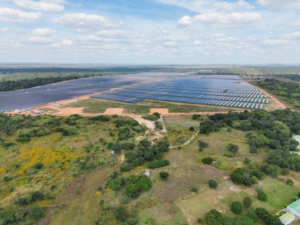
Several solar PV projects funded fully or partly by private capital are already in operation. These include Copperbelt Energy Corporation’s 136MW Itimpi II solar PV plant in Kitwe on the Copperbelt, built for $125.8m and funded with a $200m green bond.
At the time of writing, this investment, on which Bowmans advised, was the largest operational solar plant in Zambia and the third largest in sub-Saharan Africa.
The firm also advised on the 100MW Chisamba solar PV project, built for $70m through a loan from Stanbic Bank Zambia to the Kariba North Bank Extension Power Corporation, a wholly owned subsidiary of the national utility, ZESCO. The firm is also advising on Phase II of the Chisamba solar PV project, which will generate an additional 100MW.
One of the offtakers on this investment is a private company, GreenCo Power Services, which will supply energy to a copper-mining company under a 13-year power purchase agreement.
Energy regulation
To bolster private investment, the country has been reforming its energy sector regulations.
Zambia’s Electricity Open Access Framework provides for non-discriminatory access to transmission and distribution networks by third parties, while also enabling independent power producers (IPPs) and qualifying end-users to engage in power trading. Open access is part of the commitment the Zambian Government has made, and delivered on, to liberalise the energy market.
Other reforms include the Multi-Year Tariff Framework, creating a pathway for a smooth transition towards cost-reflective tariffs and a predictable policy and regulatory environment.
Also in place is the Net Metering Policy Framework, allowing consumers who generate their own energy from renewable sources to feed any excess power back into the grid, and an Energy Single Licensing System to serve as a one-stop shop for IPP licensing and permitting. The latest ZESCO records indicate that the net metering programme has passed 40MW of total capacity contributed by grid-tied prosumers.
ZESCO itself is not being neglected. A stated aim of the National Compact is to strengthen the financial and operational performance of utilities, particularly ZESCO, through operational reforms, tariff adjustments and strategic debt restructuring.
Inevitably, the changes sweeping the energy sector in Zambia will lead to new challenges. As new generation projects come online, for example, attention will shift to the transmission network, where funding has traditionally come from public sources. Here, the Government is aiming for a 70/30 ratio between private and public funding. The market will be watching eagerly to see how this unfolds.
Stability
Political stability is also a major bulwark of investor confidence. National elections in August 2026, which were largely peaceful, delivered a second five-year term to President Hakainde Hichilema. This continuity offers some comfort to investors that the reforms introduced in the first five years will continue and strengthen.
On policy and administration, the creation of a dedicated Ministry of Electricity, now headed by Peter Kapala, signals a sharper focus on Zambia’s power sector. With responsibility for electricity policy, nuclear energy, and renewable and non-renewable generation, the ministry separates electricity oversight from petroleum, an important departure from the previous structure and a potentially reassuring sign for investors seeking clearer governance and accountability.
Inflation is now firmly within the target range, and GDP growth has picked up pace, rising to 5.2% in 2025. The International Monetary Fund is forecasting growth of 5.6% for 2026. Zambia has also tamed government debt and is for the most part showing discipline in managing it down further. The country has come a long way since the sovereign debt crisis of 2020.
These high-level changes, together with energy sector reforms, will make it considerably easier for the Government to move ahead with its ambitious plans to transform the energy sector by 2030. This is bolstering the confidence of market players and investors that the country will continue to be the ‘belle of the ball’, creating an enabling environment while meeting the energy demands of citizens and industry.